
OEM & private-label glove development
Custom Work Gloves Manufacturer for OEM and Private-Label Brands
MECHDAM is a custom work gloves manufacturer in Sialkot, Pakistan, developing gloves for safety brands, PPE distributors and importers. We build each glove from your specification or reference sample: pattern, materials, protection, branding and packaging. Bulk production then follows the sample you approved, under your label.

| Typical starting MOQ | From 300 pairs per style, depending on construction |
|---|---|
| Development samples | About 7–10 working days after the specification and materials are confirmed |
| Bulk production | Typically 30–40 days after sample approval and order confirmation |
| In-house tooling | 8 CNC machines for custom TPR/PVC mould development |
| Production setup | 100+ stitching machines | 8 cutting presses |
| Quality team | 20 QC personnel within a 200+ person factory team |
What a Custom Glove Program Covers
Most private-label programs start from one of three points, and each needs a different first step:
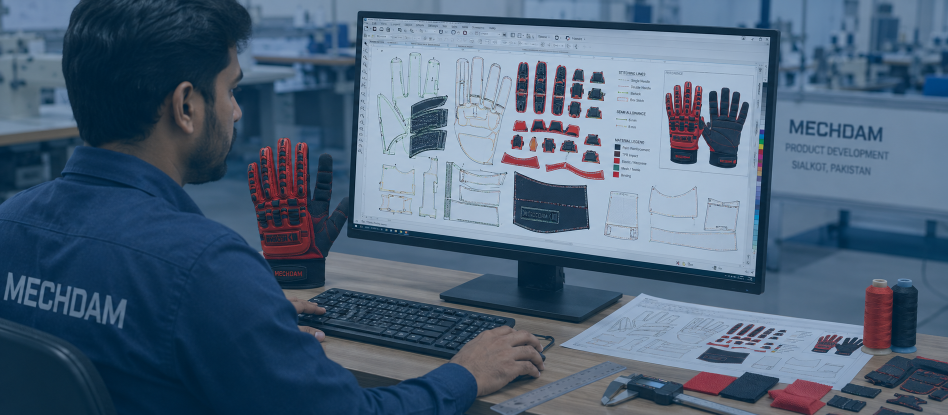
- A technical specification or tech pack. Your drawings, material callouts, tolerances and target protection levels become the basis for the pattern and the first sample.
- A physical reference sample. We review the construction of a glove you already sell or want to improve, then rebuild it on our patterns with the materials and changes you specify. You must hold the rights to any design, logo or trademark you ask us to reproduce.
- An existing MECHDAM construction. Start from a style in our work glove catalogue and change materials, colours, protection and branding.
In every case, the approved sample and the written specification become the reference for bulk production and repeat orders. That reference is what protects your brand from batch-to-batch drift.
Customisation Options at a Glance
The table summarises what can be specified on a custom work glove. Every combination is checked during technical review, because some materials, coatings and protective components are not compatible with every construction.
| Glove element | Typical options | What to specify in your RFQ |
|---|---|---|
| Style and pattern | Driver, mechanic (multi-panel), gauntlet, long-cuff and mitt constructions | Reference style or drawing, fit preference, dexterity needs |
| Palm | Goatskin, split cowhide, oil-resistant treated leather, synthetic leather | Material, thickness range, colour, palm reinforcement |
| Back of hand | Leather, stretch fabric, canvas, softshell, hi-vis fabric | Fabric type, weight (GSM), colour reference |
| Reinforcement | Palm patches, thumb saddle, fingertip and knuckle overlays | Position, material and stitching method |
| Impact protection | Moulded TPR or PVC back-of-hand and finger components | Coverage map, thickness, hardness, target impact standard |
| Cut protection | Cut-resistant liners or shell materials | Target cut level and the test method (ANSI/ISEA or EN) |
| Lining and insulation | Unlined, insulated and waterproof constructions | Warmth and waterproofing requirements, use temperature |
| Cuff and closure | Slip-on, hook-and-loop, safety cuff, gauntlet, long cuff | Cuff type and length |
| Branding | Screen printing, thermal transfer, rubber badges, woven labels | Logo positions, vector artwork, colour references |
| Packaging | Pairing ties, header cards, hangtags, printed polybags, master cartons | Barcodes/SKUs, warnings, carton marks, pack ratios |
For type-specific ranges, see our impact protection gloves, cut-resistant gloves, leather work gloves and mechanic gloves.
Glove Constructions We Develop for Private Label
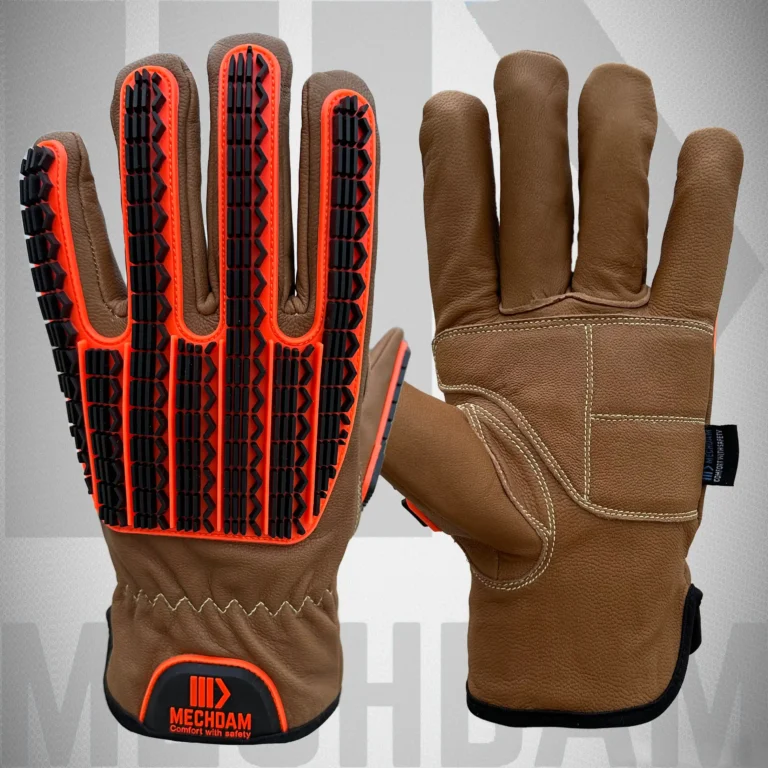
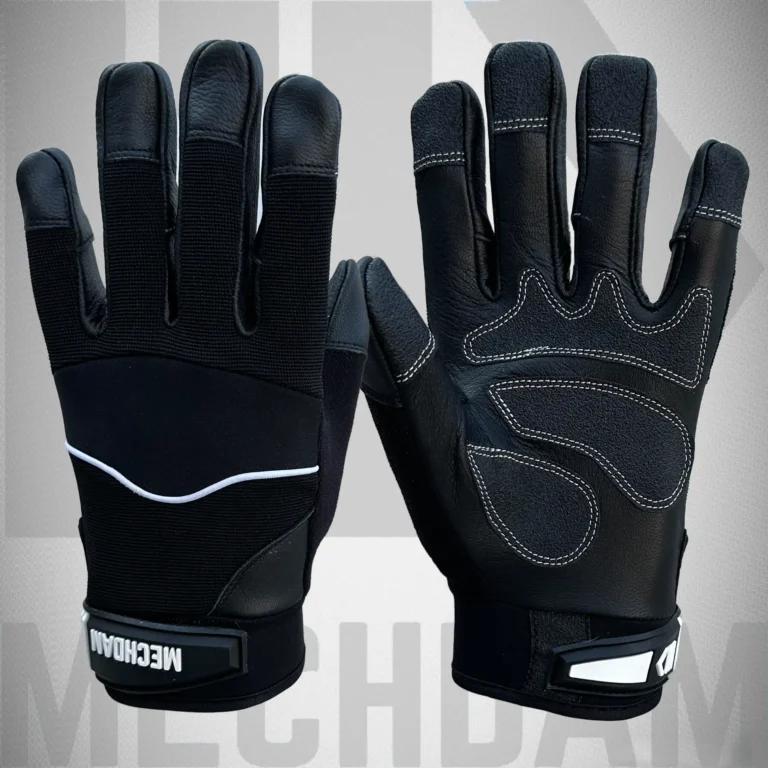
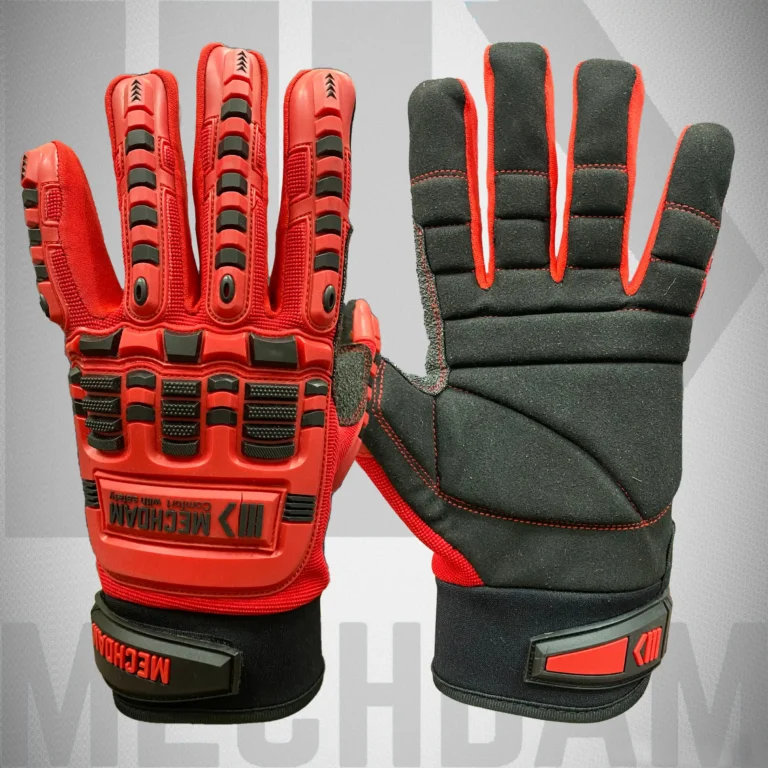
These existing MECHDAM styles show the constructions most often used as a starting point for custom programs. Each can be re-specified with your materials, colours, protection targets and branding.
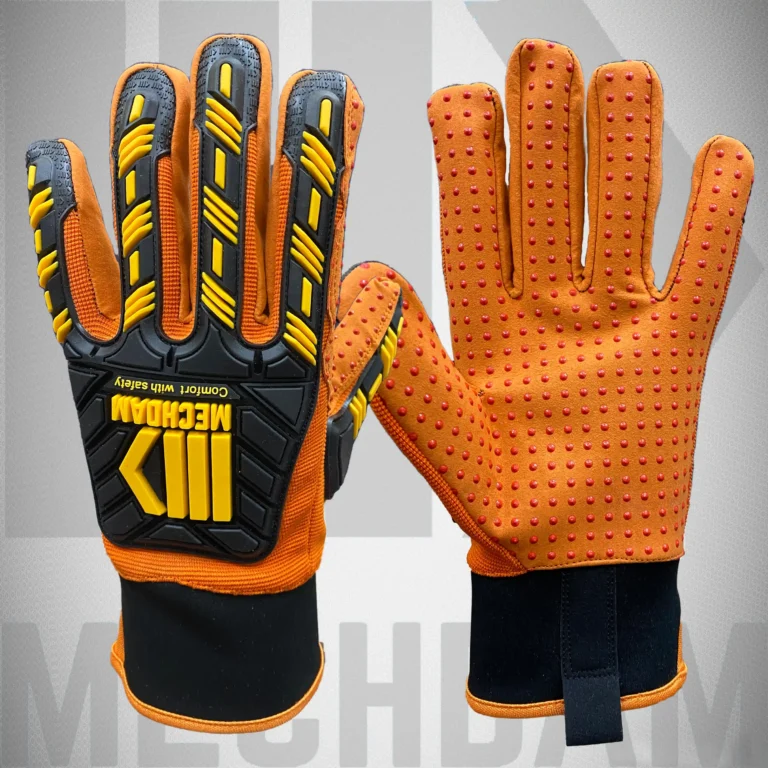
Impact protection
TPR back-of-hand and finger protection for handling and rigging work.
View impact protection gloves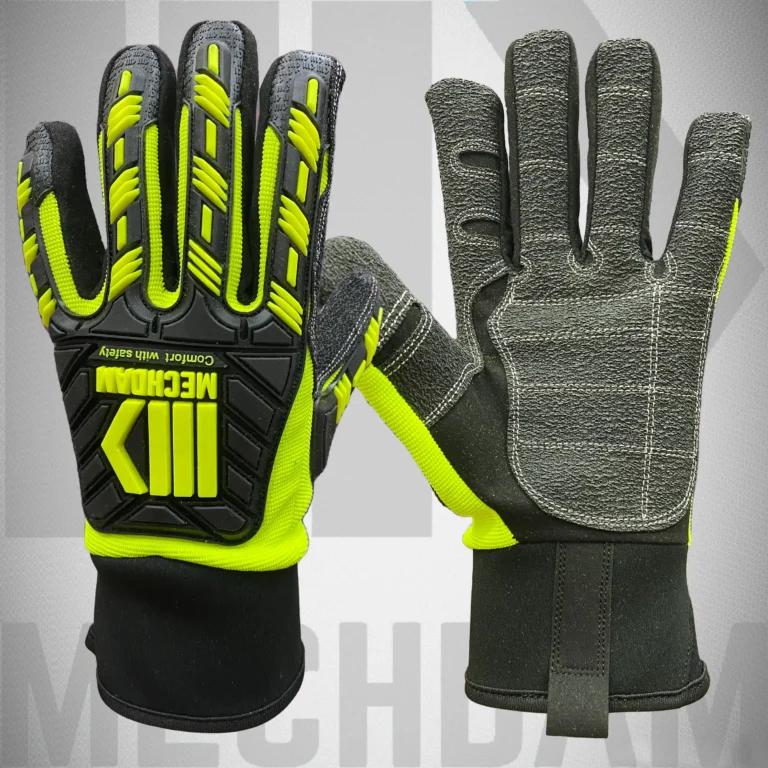
Cut-resistant
Cut-resistant constructions built to a buyer-specified target level.
View cut-resistant gloves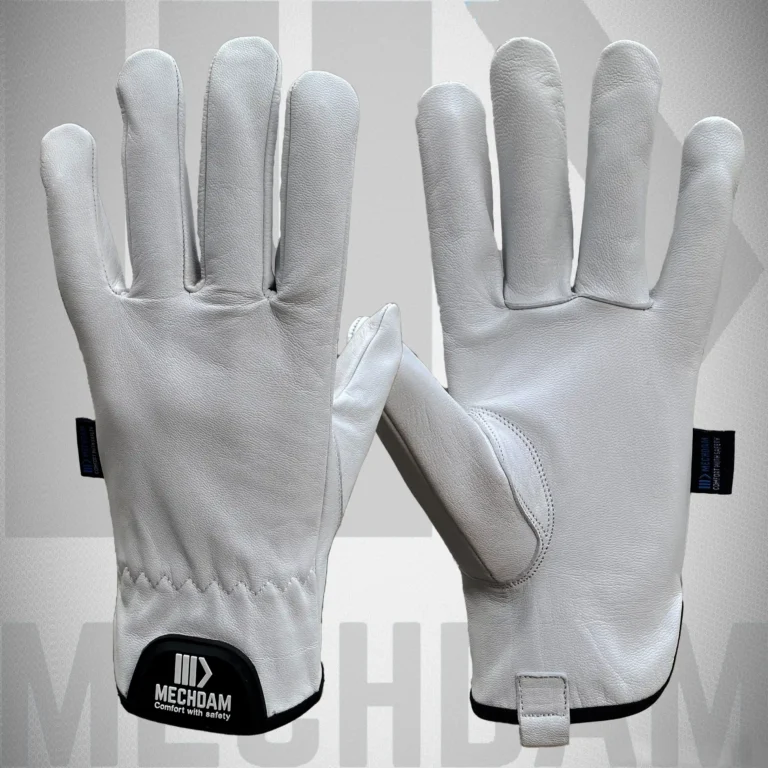
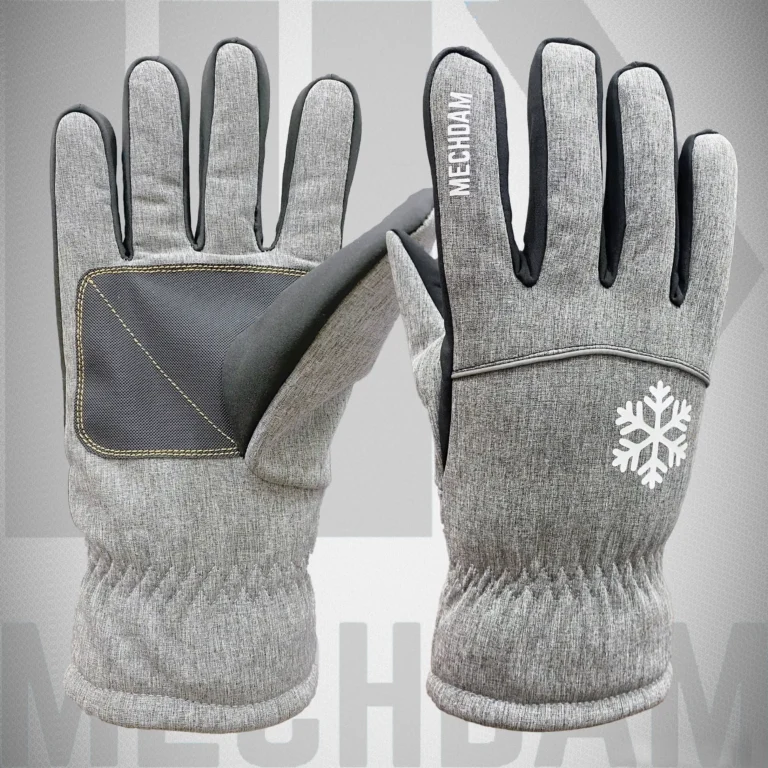
Winter & waterproof
Insulated and softshell constructions for cold, wet work.
View winter & waterproof gloves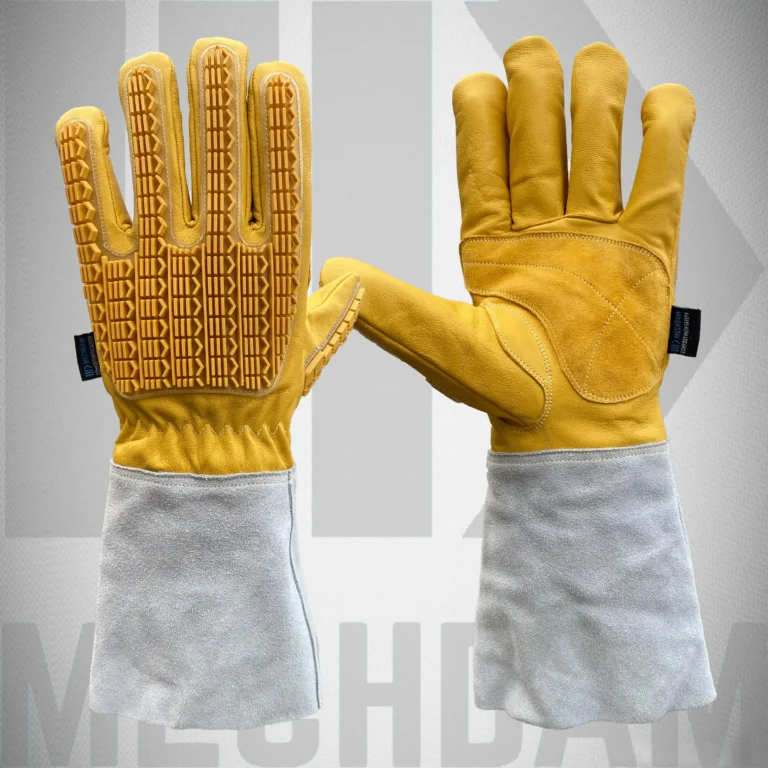
Pattern, Fit and Size Grading
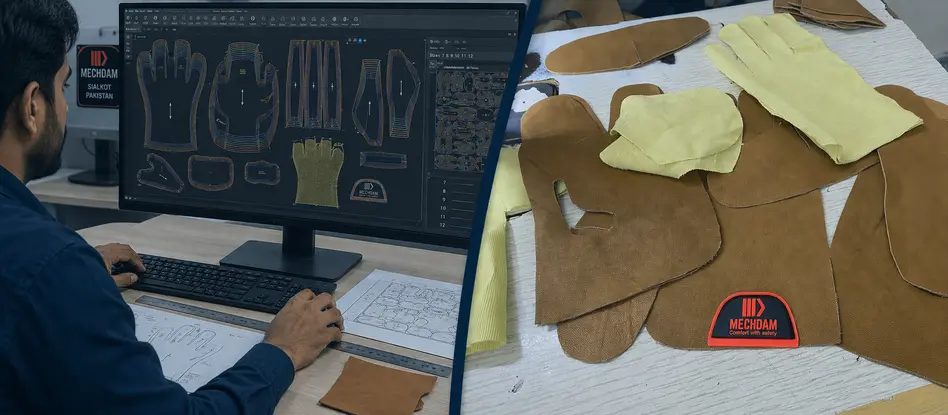
Fit decides whether a glove gets worn. Our pattern makers create standardised cutting dies and templates for each size, and grade them so that finger length, palm width and thumb position stay proportional across the size range.
To get the fit right first time, tell us:
- The sizing system your market uses. Letter sizes (S–XXL) or numbered sizes. European glove sizing is defined in EN ISO 21420.
- Your size ratio per order, so cutting and material planning match real demand.
- The intended fit. A close fit gives dexterity for mechanical work; extra room is needed when the glove is worn over a liner or in the cold.
- Any fit complaints from your current product. These are the most useful input for a pattern revision.
When a sample arrives, use our glove sample fit checklist before approving it.
Materials and Linings: Choosing the Right Trade-Off
No glove material is best at everything. The table explains the main trade-offs buyers weigh when specifying a custom glove. Exact material grades, thicknesses and availability are confirmed during technical review for each project.
| Material | Strengths | Trade-offs | Typical use |
|---|---|---|---|
| Goatskin | Soft and dexterous with good abrasion resistance for its thickness | Limited insulation; premium cost | Driver, mechanic and impact gloves |
| Cowhide (split) | Cost-effective, tough, suitable for heavy handling and welding | Rougher surface, lower dexterity | Welding and heavy materials handling |
| Oil-resistant treated leather | Helps the leather resist oil absorption and keep its grip | Higher cost; oil performance should be checked on the finished glove | Oil and gas, maintenance |
| Synthetic leather | Consistent thickness and colour, good grip, can be laundered | Less breathable; lower heat tolerance than leather | Mechanic and assembly gloves |
| Cut-resistant knit liners and shells | Cut resistance without heavy bulk | Some high-performance fibres have low heat tolerance; the cut level must be proven by testing | Sheet metal, glass, sharp-edge handling |
| Softshell, insulated and waterproof constructions | Warmth, wind and wet protection | Added bulk and reduced dexterity | Outdoor, cold-store and winter work |
Custom TPR Impact Protection, Developed In-House
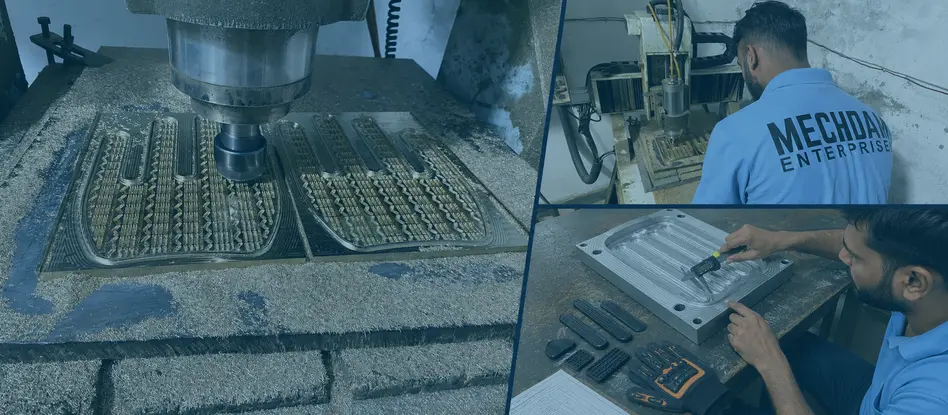
Moulded thermoplastic rubber (TPR) protection is where many custom glove projects succeed or fail. MECHDAM machines its own moulds on 8 in-house CNC machines, so a new guard design does not depend on an outside tool shop. Moulded components are then inspected for dimensions, flexibility, surface quality and Shore A hardness before they are stitched to the glove.
Points to decide with us during development:
- Coverage: knuckles, finger backs, thumb and back of hand.
- Segmentation and flex lines, so the glove still closes into a fist.
- Thickness and hardness, balancing protection against weight and flexibility.
- Attachment and ventilation around the guard.
A guard is not a rating. In the US, back-of-hand impact performance is classified under ANSI/ISEA 138-2019 (levels 1–3, with the glove rated at its lowest-scoring area). In Europe, EN 388 adds a “P” to the marking when the glove passes its optional impact test. Either rating applies only to the exact construction an accredited laboratory has tested.
Cut-Resistant Glove Development
Cut ratings are where buyers most often compare numbers that cannot be compared. Two systems are in common use, and each has its own test method:
| United States | Europe and UK | |
|---|---|---|
| Standard | ANSI/ISEA 105 (2024 edition) | EN 388:2016+A1:2018, used with EN ISO 21420:2020 |
| Cut levels | A1–A9, measured in grams of force on the ASTM F2992 test | A–F from the ISO 13997 test, plus the older Coup test score |
| What to request | The ANSI cut level and the test report | The full EN 388 marking (for example, 4X44CP) and the test report |
The two scales use different methods and are not directly convertible, so tell us which market and which standard your customers expect. Cut performance depends on the whole construction: liner or shell material, coating, leather overlays and stitching. That is why the finished glove, not the yarn, is what gets tested.
Winter and Waterproof Constructions
Cold and wet work changes the specification. Insulated and waterproof constructions add warmth and keep hands dry, but they also add bulk and reduce dexterity. The aim is to balance those against the task.
- Insulation level and lining, matched to the expected working temperature.
- Waterproof construction, where the task involves wet handling.
- Softshell or leather backs, for wind resistance and durability.
- Cuff length and closure, to keep out snow and water.
In Europe, protection against cold is assessed under EN 511, which covers convective cold, contact cold and water penetration. As with every rating, it applies only to the construction that was tested.

Logo, Branding and Private-Label Packaging
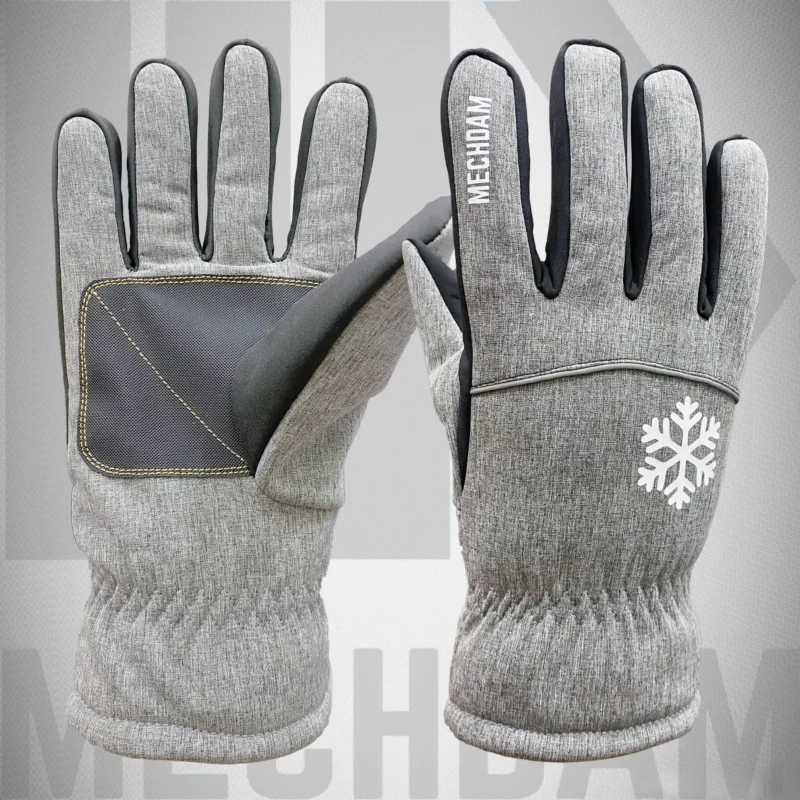
Branding is applied to individual components before stitching, so placement stays consistent across every size. Methods include screen printing, thermal transfer, rubber badges and woven labels, supplied from your vector artwork and colour references.
Retail- and distributor-ready packaging can include:
- Pairing with plastic ties, branded header cards or hangtags
- Inner polybags printed with barcodes, SKU numbers and suffocation warnings
- Corrugated export master cartons with your shipping marks and pack ratios
Please supply your own barcode numbers (for example GTIN/UPC/EAN) and approve all printed proofs before production.
Testing, Certification and Who Is Responsible
We manufacture to your target specification. A glove is only rated to a standard when an accredited laboratory has tested that exact construction and issued a report. A rating on one model does not transfer to another.
When an order is confirmed, we arrange testing to the standard and performance level you require. Testing is carried out by independent third-party laboratories, which issue the test report or certificate for the tested construction. The standard, target level, laboratory, report format, cost and timing are agreed with you before testing begins.
Standards and Responsibilities by Market
| Market | Key references | What it means for a private-label buyer |
|---|---|---|
| United States | OSHA 29 CFR 1910.138 (employer duty to select suitable hand protection); ANSI/ISEA 105 and ANSI/ISEA 138 (voluntary classification standards) | Your customers select gloves by tested performance, so publish ratings only from test reports on the exact construction. |
| European Union | Regulation (EU) 2016/425 on PPE; EN ISO 21420, EN 388, EN 511 and other harmonised standards | A company that places PPE on the EU market under its own name or trademark is treated as the manufacturer (Article 12), with the manufacturer’s conformity, CE-marking and documentation obligations. |
| United Kingdom | The PPE Regulation as it applies in Great Britain; HSE guidance on choosing gloves | Confirm the current marking and conformity requirements for GB with your conformity assessment body before launch. |
| Canada | Provincial occupational health and safety rules; CCOHS glove selection guidance | Confirm which performance ratings your Canadian customers require before testing. |
Anti-vibration gloves: the UK HSE advises that the vibration reduction of anti-vibration gloves usually cannot be assessed in use. Treat these gloves as one part of a vibration-control program, not a substitute for it.
From RFQ to Approved Sample to Bulk Order
RFQ and commercial review
We review glove types, quantities, target markets, compliance needs and shipping terms (for example FOB, CIF or Ex-Works).
Technical assessment
Our team evaluates the construction, application, materials and seams, and flags any manufacturing risk before sampling.
Development sample
About 7–10 working days after the specification and required materials are confirmed. New tooling, material development or testing adds time.
Review and revisions
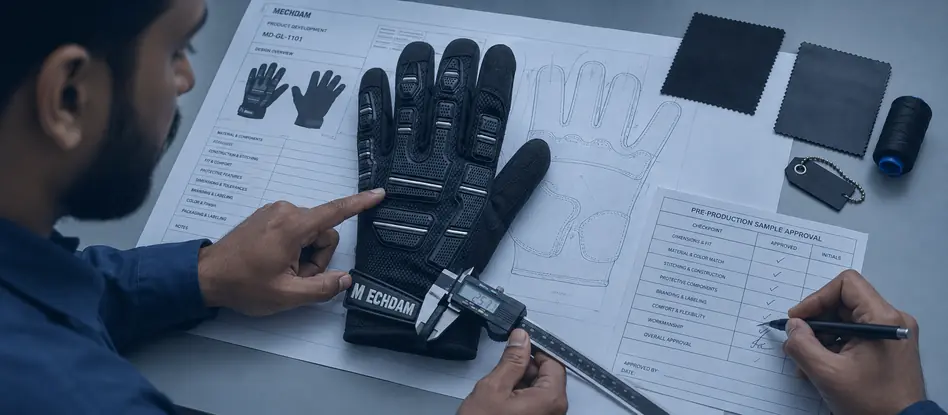
You review fit, materials, flexibility, branding and workmanship. Changes are recorded and a revised sample is made where needed.
Pre-production sample sign-off
The approved sample becomes the reference for bulk production and for every repeat order.
Material procurement and incoming QC
Leather, fabrics, threads, trims and protective components are allocated and inspected against the approved specification.
Bulk production
Typically 30–40 days after sample approval and order confirmation, with progress updates (photos, short videos or status reports) at agreed milestones.
Final inspection and optional third-party inspection
Your nominated inspection company can carry out in-process, pre-shipment or container-loading checks.
Packing, documents and shipment
Commercial invoice, packing list, certificate of origin and bill of lading are prepared under the agreed Incoterms.
Quality-Control Checkpoints
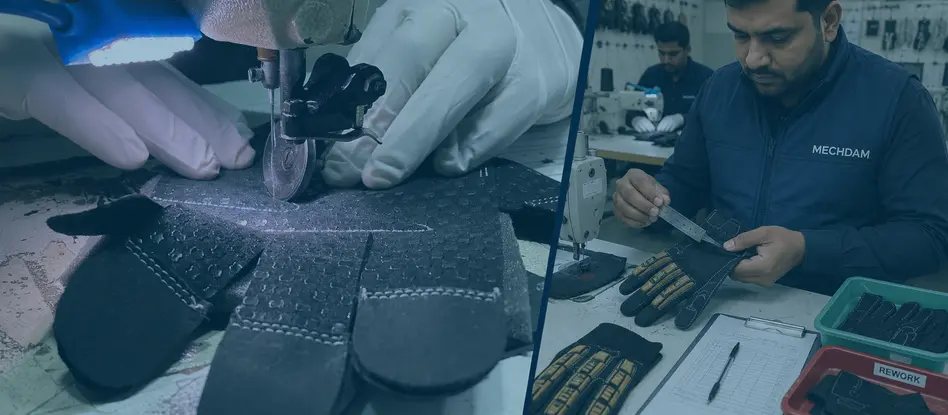
Quality on a private-label program depends on catching problems before they are stitched into thousands of pairs. Our checkpoints run from incoming materials to export cartons:
- Incoming material control on each material lot: leather thickness and appearance, fabric weight, colour and trims.
- First-piece approval at line start and after any change of style, size, material or operator setup.
- In-process checks during assembly: seam position, stitch density, component alignment and reinforcement.
- Final quality assurance: dimensions, workmanship, pairing, labels and closures.
- Pre-dispatch audit: carton quantities, SKUs, shipping marks and barcode scannability.
See the full quality-control process and inspection frequencies.
MOQ, Lead Times and Production Planning
Our typical starting MOQ is 300 pairs per style. The final MOQ depends on the glove construction, custom colours or materials, the size range, new TPR/PVC tooling, branding and packaging. Normal capacity is about 2,500 pairs per working day (around 50,000 pairs per month). Actual output varies with construction, material availability and order complexity.
To keep a launch date realistic:
- Allow time for at least one sample revision. Most programs need it.
- Confirm testing requirements before bulk production. A failed test means changing the construction and sampling again.
- Order seasonal products, such as winter gloves, well ahead of the selling season.
- Keep your size ratio and packaging artwork final before production starts. Late artwork changes are a common cause of delay.
Custom Glove RFQ Specification Checklist
A complete RFQ gets you an accurate quotation and a first sample that is closer to final. Use this checklist when you contact us. Anything you are not sure about can be agreed during technical review.
| Item | What to include |
|---|---|
| Application | Industry, tasks and how long the glove is worn per shift |
| Hazards | Cut, impact, abrasion, puncture, heat, cold, wet, oil or vibration, and which matter most |
| Target market and standard | For example ANSI/ISEA 105 cut level, ANSI/ISEA 138 impact level, EN 388 marking or EN 511 |
| Testing | Whether testing is required, the preferred laboratory, the report format and who pays |
| Style and cuff | Reference style, photos or drawings; cuff type and length |
| Materials | Palm, back, lining, reinforcements and protective components |
| Colours | Colour references for leather, fabric, guards and branding |
| Sizes | Size range and size ratio per order |
| Branding | Methods, positions and vector artwork |
| Packaging | Pairing, header card or hangtag, polybag, barcodes, carton marks, inner and outer quantities |
| Quantities | Pairs per style for the first order and expected repeat volume |
| Reference sample | A physical sample of the glove you want to match or improve, if available |
| Delivery | Destination port or address, preferred Incoterms and required delivery date |
| Compliance documents | Declarations, user instructions and labelling your market requires |
Custom Work Gloves: Frequently Asked Questions
Can you make a glove based on one we already sell?
Yes. We can review a physical reference sample and rebuild it on our patterns with the materials and changes you specify. You must hold the rights to any design, logo or trademark you ask us to reproduce.
What is the minimum order for custom work gloves?
The typical starting MOQ is 300 pairs per style. The final MOQ depends on the construction, custom colours or materials, the size range, new TPR/PVC tooling, branding and packaging.
How long does it take from RFQ to bulk shipment?
Development samples typically take about 7–10 working days after the specification and materials are confirmed, plus time for any revisions. Bulk production typically takes 30–40 days after sample approval and order confirmation, followed by transit to your destination. New tooling, testing and complex packaging can add time.
Do you charge for custom samples?
Sample costs are calculated individually, because material use, custom branding, pattern work, TPR components and the number of designs vary from project to project.
Can you develop a new TPR impact guard design?
Yes. We machine product-specific moulds for TPR or PVC back-of-hand and finger components in-house. Mould development time, component hardness, thickness, placement and any impact-test target are confirmed for each project.
Are your custom gloves certified to EN 388 or ANSI/ISEA standards?
We manufacture to your target specification. When an order is confirmed, we arrange testing to the standard you require at an independent third-party laboratory, which issues the test report or certificate. The standard, target level, laboratory, cost and timing are agreed with you first, and a result covers only the construction that was tested.
Who is responsible for CE marking when gloves are sold under our brand?
In the EU, a company that places PPE on the market under its own name or trademark is treated as the manufacturer under Regulation (EU) 2016/425 and takes on the manufacturer's obligations. We supply construction and material information and samples to support your conformity assessment.
Can our own inspector check the order?
Yes. You can nominate an independent inspection company for in-process, pre-shipment or container-loading inspection. The scope, sampling level, acceptance criteria and timing should be agreed before production.
Can we visit the factory or see production on video?
Yes. You can request an appointment to visit our facilities in Sialkot, Pakistan, or a live video call of the relevant production areas. Both are scheduled in advance.
What information do you need to quote a custom glove?
The application and hazards, the target standard and level, the style, materials, colours, size range, branding, packaging, quantity per style, delivery destination and required date. The RFQ checklist on this page covers each item.
Request a Custom Glove Quote
Working with a custom work gloves manufacturer starts with a clear brief. Send us your specification, reference sample photos or tech pack. Our team will review the construction and reply with questions, a quotation and a sampling plan. Already sourcing a standard range? Explore our industrial work gloves, construction work gloves and safety glove supply programs, or read our private label work gloves buyer guide.